‘In Sarah Longworth-West’s painting ‘Swell’, the form making the most immediate claim on our attention is an irregularly shaped swathe of blue, thoroughly articulated with extensive folds and intricate creases. The painting to some degree restages(1) the artist’s apprehending of this tarpaulin from the next street over to their old flat, attentive to both the billowing overallness, its either cut or torn lower flaps, and the phenomena of its surface variegation – moments of sheen and drapery-like convolution. As Merleau-Ponty tells us, to see is to ‘have at a distance’, and Longworth- West removes all worldly context – save for lengths of scaffold that indicate where the ground might have been – floating the tarp above an indeterminate, shifting space (and recontextualised with forms from elsewhere). It has a topographical aspect, like a modelled landscape diorama suspended upright, and thus a strangely horizonless terrain, but is also something like a baleful scrap of wrapping paper, prone, torn and liable to be blown away. Palpably stirring in an evoked breeze, we have the feeling that this object is ‘about to change...something (is) imminent in this tension, as the storm is imminent in the clouds’(2).
Caught between pliability and brittleness (perhaps a side effect of the cool acuity of Longworth-West’s attention in paint), the crisp intricacy of the tarp also suggests ‘the touch and feel of a leaf’, sought by Paul Nash – the lodestar of this exhibition – as a defining quality in his art(3). ‘Out there’, it surely made itself known to Longworth- West as an opportunity to access the two sorts of loneliness that de Chirico identified as fundamental to ‘every serious work of art’; the ‘plastic loneliness’ or ‘beatitude of contemplation’ achieved via construction and combination of form and the ‘metaphysical loneliness for which no logical training exists’. The ‘swell’ of the painting’s title surely alludes to a surge in voluminosity as the tarp is animated by a breeze, but perhaps an incipient feeling making itself known, too. For a painter, the stimmung of an observed phenomena and its capacity to move may be tangled with the realisation this thing might be paintable.’
Footnotes: (1) Perhaps in a ‘rite of worship’, as Auden would characterise the impulse to create. (2) Maurice Merleau-Ponty, Phenomenology of Perception, 2014 edition, Routledge, p.41. (3) Paul Nash 1930s letter to The Times, cited in Derek Hyatt, ‘Paul Nash and the Megaliths’, Modern Painters Winter 1994 p.66.
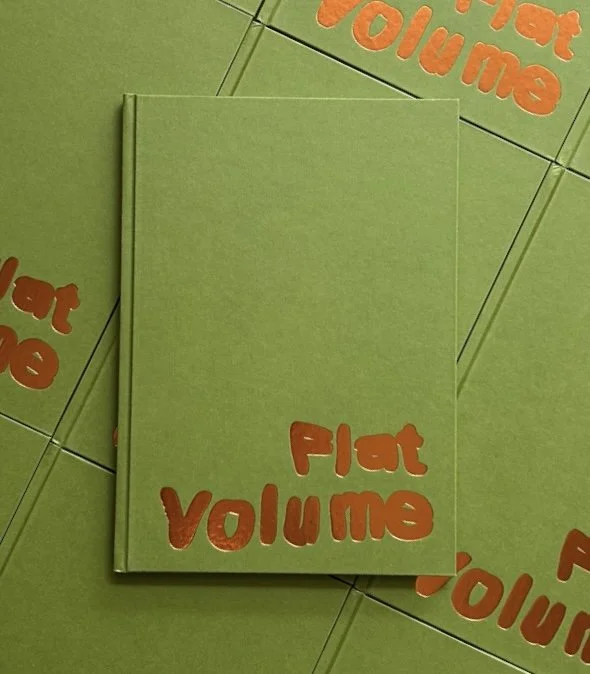
- Extract from ‘Enfolded out There’ by Nicholas Hatfull Oct 2025. Essay in the ‘Flat Volume’ Publication


2022 Painted Conversations - Sarah Longworth-West + Marcus Murison, Project Dialogue e.book.
Curators: Lyndsey Gilmour + Peter Chalmers



Academic Paper: “10 + EXTEND”: how can we teach painting to students who already think they know what painting is?
Co-authored with Dr. Sarah Horton representing Norwich University of the Arts.
Delivered at Teaching Painting: Conference at The Whitworth Museum, Manchester in partnership with Manchester School of Art.
Teaching Painting : How can painting be taught in art schools? Published by Black Dog. 2016.
Member of ‘Teaching Painting: Steering Group’ (from 2016)